This is part 10 of an ongoing series of articles. If you haven't already please read parts 1, 2, 3, 4, 5, 6, 7, 8 and 9.
This is going to be the last part of our intro series where we are introducing new information. Our focus in this article is going to be on evaluating transits. Transits were introduced in part 2 and in part 9 we did an actual evaluation of transits using our example native's chart. In our last part we did examples taking into account transits based on current planetary positions only with no natal chart information (since it reflects our transit reviews in our ceremonies), influences based on the natal position of planets, and influences based on transiting the houses of the natal chart. In this part we are going to review taking into account the current positions in the sky, and their interaction with each other, while also taking into account the information about the house rulership from the natal chart.
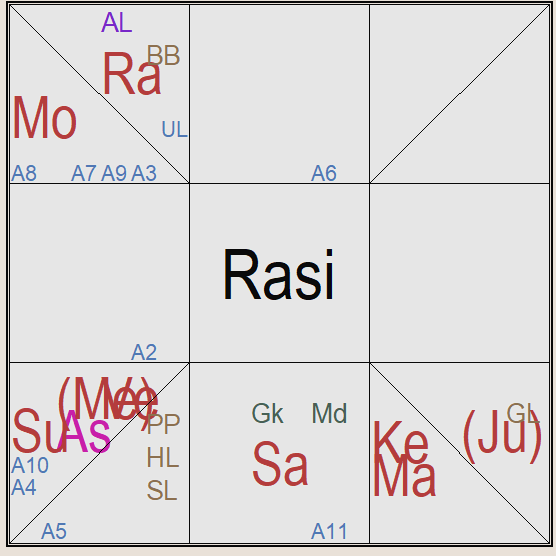
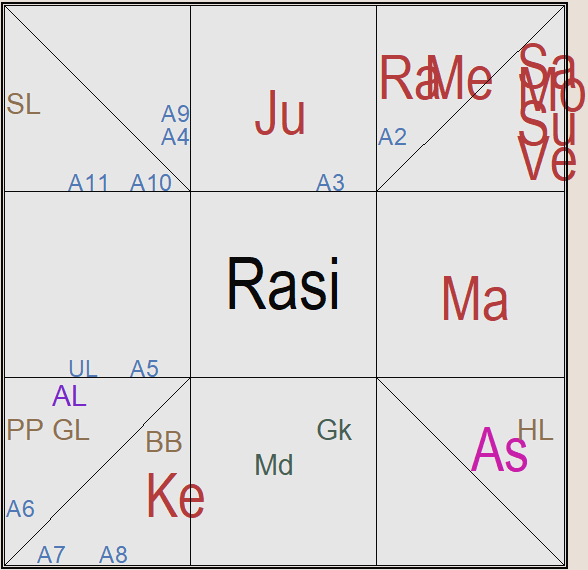
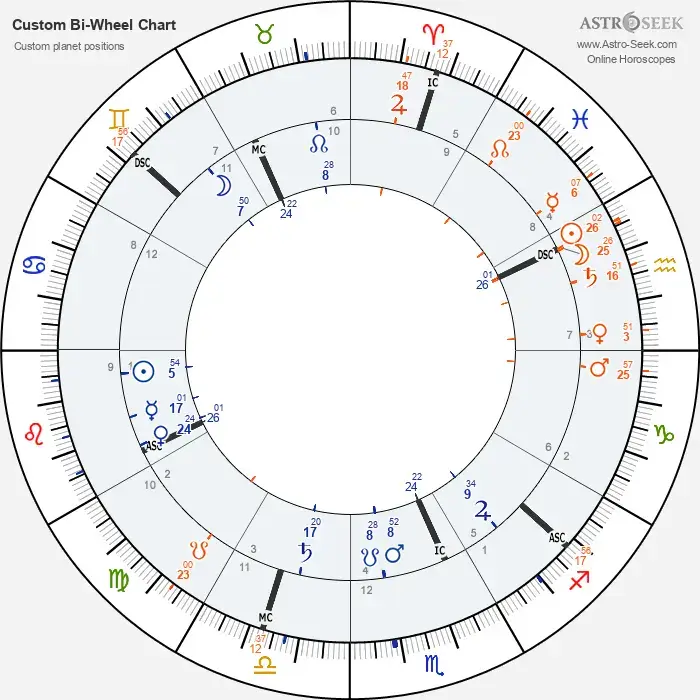
Below are three images; the first is the natal chart from our example, which is from August 22, 1984 at 8am in New York City. The second chart on are the transits at the point of our new moon on March 10th, 2024 at 4:00am in New York City. These first two charts are using the Vedic East Indian format. The third chart is a tropical-style chart where the placement of the planets colored orange are the transits and the planets in blue are the natal positions.
Transiting Planets Interacting With Each Other
When we are considering the transiting planets interacting with each other, what we are referencing aspects and conjunctions between planets in the second vedic chart, or orange colored planets from the tropical chart. We are disregarding any interaction with the planetary placements in the first vedic chart or in blue in the tropical chart. The benefit of the tropical chart here is that we can use the blue planetary symbols as a quick, easy reference to understand what house the planets were in and ruled over in the natal chart, and we will take that information into account while reviewing the activity between the planets based on where they are currently in the sky.
At first glance one thing that stands out (which was also alluded to in part 9) is that almost all of the planets are bunched up on one side of the chart! There are always at least two signs populated with planets when we are considering the basic planets of Vedic astrology because Ketu and Rahu (the south and north nodes) are always on opposite sides of the sky from each other. In our transit chart, we have only 5 signs filled with planets, and we're almost at 4 since Mars is right on the cusp of going into Aquarius there. So this is a bit of a rare circumstance, but then again when it comes to incredibly long, repeating cycles like this it's bound to happen every once in a while.
To supplement our images up there, here's a quick summary of the current placements, conjunctions, and aspects in table format that may be easier for the non-astrologer to digest. You may notice that this table is like a blend of the tables we created in part 9 of this series. We include rulership information but no columns for the natal positions of planets because we aren't considering that. Comparing it to the tables table from part 9 may help reinforce an understanding of what we are reviewing in this part.
| Planet |
House Rulership |
Current Placement |
Conjunct | Aspecting | Receiving Aspects |
|---|---|---|---|---|---|
| Sun | 1st |
7th House Aquarius |
Moon, Saturn, Venus |
|
|
| Moon | 12th |
7th House Aquarius |
Sun, Saturn, Venus |
|
|
| Mercury | 2nd and 11th |
8th House Pisces |
Rahu |
|
|
| Venus | 3rd and 10th |
7th House Aquarius |
Moon, Saturn, Sun |
|
|
| Mars | 4th and 9th |
6th House Capricorn |
Jupiter | ||
| Jupiter | 5th and 8th |
9th House Aries |
Saturn, Mars | ||
| Saturn | 6th and 7th |
7th House Aquarius |
Sun, Moon, Venus | Jupiter |
|
| Rahu | 4th |
8th House Pisces |
Mercury | Ketu | Ketu |
| Ketu | 7th |
2nd House Virgo |
Rahu | Rahu |
As we can see the placements are very similar to where they were about month ago. The Sun advanced a sign and Mercury and Venus both advanced two signs. This is quote normal considering the Sun moves one every month, and Venus and Mercury closely follow since they are the closest planets to the Sun. I didn't reference the Moon because it does one complete cycle of the Zodiac about every month so technically it has gone 13 signs.
To do a little astronomical recap - a lunar month is the period of time between a Moon repeating a lunar phase. So, the time between two full moons, two new moons, etc. This is about 29.5 days, and is also referred to as a synodic month. A sidereal month is the amount of time until the Moon reaches the exact same point in the sky, against the fixed stars of the Zodiac, and that is around 27.3 days. The reason for this is because the Sun advances through the Zodiac (due to the Earth's apparent motion around it) so it takes a little extra time for the Moon to 'catch up' to the new position of the Sun compared to where it was the last time a new moon happened. That's why the Moon will normally progress through 13 signs between new moons.
Some Evaluation
The stand out situation in the current transit chart is certainly the conjunction of the Sun, Moon, Venus and Saturn in Aquarius. This conjunction blends the energies of the 1st (Sun), 3rd (Venus), 6th, 7th (Saturn), 10th (Venus) and 12th (Moon) houses. We could go the full gamut here and consider what happens when you blend the energies of the 1st with the 3rd, 1st with the 6th and so on; then the 3rd with the 6th, 7th, 10th; then the 6th with the 7th, 10th and so on. But, that would be time consuming and inundate us with too much information, so we'll pick apart some of the combinations that seem to be more significant based on the ruled houses sharing significations.
The dusthana houses are house numbers 6, 8 and 12. In our transits, we have Saturn, the lord of the 6th conjoined with the Moon the lord of the 12th. We review the dusthana qualities of the 6th in part 6 and the 12th in part in part 8. So, since we have two rulers of planets that are in houses of suffering, they may bring those qualities into the mix. Also consider that the lord of the 6th is Saturn, a notorious malefic. So we have a few different things here that seem to support the idea that what's going on in this house could be very challenging. Considering Venus is in there, and Venus it the lord of the 3rd and 10th, that could mean that our native is currently facing challenges related to things of the 3rd house (like communication, intellectual pursuits, or their siblings) or the 10th house (career, karma). Or, consider the Sun, the ruler of the 1st house which relates to the self and health; maybe the individual would be facing some health challenges during this time.
As we referenced in part 8, houses 3 and 7 are both kama houses, or houses related to desire. Venus and Saturn are lords of those houses, so we have two lords of houses of desire present in this conjunction. If we combine that with what we were just mentioning about lords of houses of suffering being present in this conjunction, maybe this would be a very challenging time for someone as it relates to their desires. Perhaps, in this case, since it's the lord of the 3rd and 7th it could be that communication (3rd house) with a partner (7th house) is especially strained during this time.
Also in the transit we have Jupiter (lord 5 and 8) receiving the dual aspects of Saturn (lord 6 and 7) and Mars (lord 4 and 9). When we are considering these transits, since they are not 'exchanging aspects' (which would be if the planets are across the sky from each other) it is purely Jupiter that is receiving the influence of these two. In this case, there aren't a lot of common themes shared among houses 4, 6, 7 and 9 (the houses that the aspecting planets rule over) so it's may not be immediately apparent how this could affect Jupiter. But, houses 5 and 9 are both Dharma and Kona (luck) houses, so maybe things related to the 8th house (since that's Jupiter's other rulership) may experience some 'lucky' things during this period. Houses 4 and 8 are both Moksha (spiritual liberation) houses, so perhaps our native would have spiritual experiences which originate out of things related to the 5th house.
I think this is enough to illustrate how astrological influences may combine during transits by virtue of the houses that interacting planets have rulership over in a natal chart. The possible combinations could seem endless.
In Practice
Now, when you are really evaluating transits, one may not take the approach we have over the past two articles where we're comparing transiting planets against natal planets, natal houses, and other transiting planets separately. Really one would take all of these things into consideration at the same time. We just broke them down this way in the article to help digest them in little pieces since processing all of the information available in transits can definitely be a bit overwhelming. And also when it comes to evaluating transits, it wouldn't be common to evaluate and take in all of that information anyways. I know some of what follows was mentioned in the last part of this series but it bears repeating.
Normally there's a specific focus, and then transits are evaluated to figure that out. For example, I may be facing issues in the office, so I may take a look at the chart and see if the houses and planets related to work environment may be effected. And, if you notice anything like that, one could then try to discern if there is any action that could be taken to improve the situation. The other common example is predictions. Say I am looking to change my career; first, if I am familiar with my chart I know what planets and signs may influence something like that; then, I would use some type of software to observe the transits over upcoming months to see if there is an opportune time to make such a change.
So, say, for example, the individual that our example chart was for was experiencing a very intense time in their relationship, and they wanted to reference astrology to see if they could gain any insights. They'd look at the charts like we did and notice that the Sun, Moon, Venus and Saturn are all conjoined in the 7th house, a major house when it comes to relationships. The Sun and Moon being representative of the divine masculine and feminine, along with Venus and its correlation to romance, sitting with Saturn the ruler of the 7th, all certainly point to a potentially high energy situation surrounding relationships.
And, to use the same example, say someone was looking for a time to propose to their partner, so they wanted to look at the transits to find an opportune time. They may come across this period in March 2024 and see all of that activity there and decide that it actually is an opportune time since the lord of the 7th (Saturn) is in the 7th with all of those accompanying planets. Then again, they could also see that and choose the exact opposite, to avoid that time, because they want it to be more subtle and relaxed when they choose to propose.
A serious question when looking at this amount of information is "how do we know which of theses things might happen, or which things to take into consideration?" That really comes down to experience. It would take someone with a lot of experience in astrology that also has a good gauge on the person they are giving a reading for. But, since we are talking about using this for ourselves, to become closer to god, it's about getting to know one's own chart and coming to understand the role that each of these planets play in our life. A simple way to understand this is to take, for example, the 3rd house. It relates to siblings. Well, if someone doesn't have any siblings, they wouldn't consider that when looking at their chart or transits. When we start to see the roles that each of these planets fulfill by knowing ourselves and our charts, we can easily filter out 80-90% of the information available in a chart and utilize what we know applies to us and how it does.
Taking A Step Back
At this point we have completed our overview of astrology using an example birth chart, and more specifically transits over the last two parts. We've covered the basics of how one can put astrology into practice for themselves. It was my experience growing up that Astrology was like the old saying that "even a broken clock is right twice a day." But once I started to understand how complex it was, I realized how it could truly be reflective of our selves and a lens through which to see divine patterns in nature and how we are a part of that. And hopefully, for anyone that's had the patience and will to track along this whole time, it's also exposed the ways in which Astrology can help one gain insights into these patterns and themselves as a result.
Although we've completed our introductory review, we are going to do one more article to recap everything we've gone over. I think it'll help especially because transits can become quite complicated and just leaving off on the most complicated part of our introduction just doesn't feel right. So if you've been enjoying these so far but feel a little lost after our last two don't fret! We're going to bring this full circle. No Zodiac pun intended ;)