This article is a follow up article to Astrology Intro: Bringing Us Closer To God (Pt 1) and Astrology Intro: Bringing Us Closer To God (Pt 2), so if you haven't already read those it's a good idea to do it before continuing with this.
I'll start this off with a recap of our previous articles just like last time. In part 1 we did a quick overview of the roles that planets, signs and houses can play in astrology. In part 2 we started to go over transits since they are incorporated into our ceremonies, and are a major part of using astrology day-by-day to understand the energies that are progressing, and we can then use these to inform ourselves of how to make decisions that may bring benefit to us and all.
This article we're going to use an example natal chart to start to put into practice some of what we had discussed in part 1 of this series of articles. So we'll simply be going over the placement of the houses and the planets in the signs of the Zodiac, and start to dig a bit more into planetary rulership and evaluating whether a planet's placement is one that we think of as "good" or "bad". In the part 2 article, I came up with some sample birth information which was a person born on August 22, 1984 at 8am in New York City.
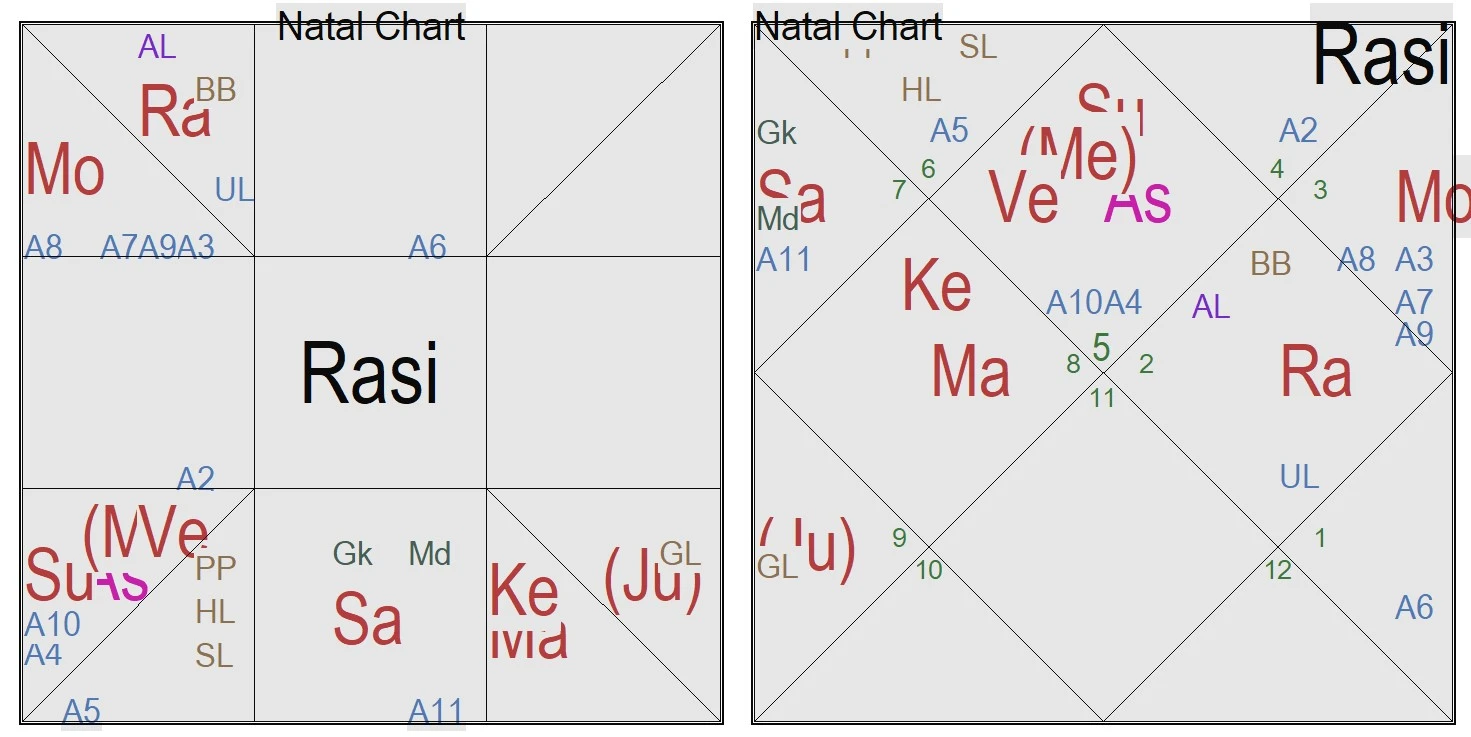
These are two images of the same chart displayed differently. In Vedic astrology these are the eastern style chart (left) and northern style chart (right). The eastern style chart always has Aries as the sign in the top center square. This one I find convenient for telling which signs the planets are placed in. The northern style chart always has the ascendant (the first house) in the top center square. This can be an easier chart to read to tell which houses are where. In the northern style chart, the number of the signs are placed in the squares, so you can see a "5" in the bottom of the top center square, and that indicates Leo, the fifth sign. In these charts, parenthesis around the abbreviation of a planet means that the planet is currently retrograde.
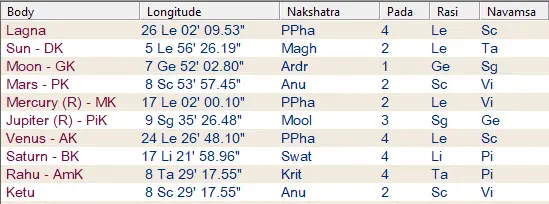
This image shows the planets and the signs they are placed in. The "Body" column shows the planet or body's name (Lagna is the ascendant or point on the horizon). The hyphen after the names are karakas or significators, which we will not go into. The (R) in that column means the planet is retrograde. The "Longitude" column shows the exact placement in the sign. Nakshatras are lunar mansions; similar to signs, they are a way of dividing to sky. A Pada is a subdivision of the Nakshatra. Rasi means the birth chart, so in that column it will display the sign that the planet is in in the natal chart. Navamsa is a divisional chart, and the sign abbreviations in those columns are signs indicating the planet's placement in the divisional chart. We won't go into divisional charts at all but I will just say that Vedic astrology uses these for various reasons such as taking a view at specific realms of experience of life (such as spiritual life), past lives, or other things.
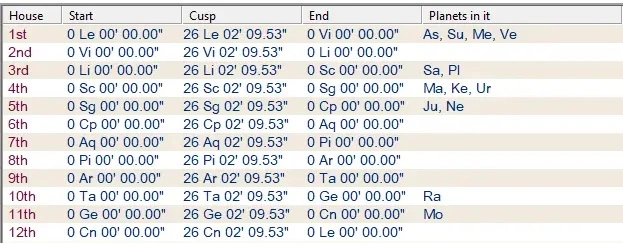
This image shows the placements of the twelve houses in the signs. The method that I was taught is to have one house be in each sign, so as you can see the houses start at the 0 degrees in a sign and end at the start of the next sign. Some methods will have the houses span multiple signs and have the first sign start at the exact degree of the ascendant. In this image, there's also a convenient column to help see which planets are placed in each house. This can be beneficial, but I don't ever really use the interface shown in this image. Normally you just figure it out based on one of the two charts, but I figured in this case it's useful to show it in this table format and just to let people know how some of these tools can be used.
Much of the data in the second two images can be discerned by looking at the chart images themselves. I just wanted to present them here this way since it does provide some additional data and honestly I would've typed out a lot of that otherwise ;)
The next major part of reading our charts that I want to go over is the rulership of planets. Each planet, except for the two luminaries (the Sun and the Moon) rules two signs:
- Sun rules Leo
- Moon rules Cancer
- Mercury rules Gemini and Virgo
- Venus rules Taurus and Libra
- Mars rules Aries and Scorpio
- Jupiter rules Pisces and Sagittarius
- Saturn rules Aquarius and Capricorn
In addition to those, what I was taught is that Rahu and Ketu are co-rulers of signs. This doesn't exactly carry the same weight as any of the 7 planets, but there is influence. Some schools of thought do not follow this, and say they rule no signs, but since I was taught this way I will be using it and passing it on. We will take this information into account when reading our charts, although with less significance.
- Ketu co-rules Scorpio (with Mars)
- Rahu co-rules Aquarius (with Saturn)
For this chart, that means:
- Sun rules the 1st house
- Moon rules the 12th house
- Mercury rules the 11th and 2nd houses
- Venus rules the 10th and 3rd houses
- Mars rules the 9th and 4th houses
- Jupiter rules the 8th and 5th houses
- Saturn rules the 7th and 6th houses
- Ketu rules the 4th house
- Rahu rules the 7th house
This means that the Sun brings its significations, which I like to think of as personality traits or characteristics, into the first house, which is related to the self, the body, health, and other significations. The same goes for the rest of the placements; as rulers of the houses, they govern over them according to their traits and characteristics. We won't go deeply into what each planet's or houses significations are in this article. That information is available in a lot of places online if anyone is interested, and we will dive more deeply into that in future articles; but for right now we are just going to start to paint the pictures for how these things work together.
Another important part of the way this works is that house rulerships of the planets also influence the house they are placed in. Think of it as if you had an administrator for a specific office coming into your home. His perspective is going to be filtered through his role as an administrator, in addition to personality traits that he may have. So, when we are talking about placements, another useful way to look at this information is:
- The lord of the 1st house (Sun) is placed in the 1st house (in Leo)
- The lord of the 12th house (Moon) is placed in the 11th house (in Gemini)
- The lord of the 11th and 2nd houses (Mercury) is placed in the 1st house (in Leo)
- The lord of the 10th and 3rd houses (Venus) is placed in the 1st house (in Leo)
- The lord of the 9th and 4th houses (Mars) is placed in the 4th house (in Scorpio)
- The lord of the 8th and 5th houses (Jupiter) is placed in the 5th house (in Sagittarius)
- The lord of the 7th and 6th houses (Saturn) is placed in the 3rd house (in Libra)
- The lord of the 4th house (Ketu) is placed in the 4th house (in Scorpio)
- The lord of the 7th house (Rahu) is placed in the 10th house (in Taurus)
Looking at things this way, we can start to see the serious interplay of energies that go in in our natal charts. Each planet not only brings its own characteristics to the house that they are ruling, but into the house that they are placed in. And, each planet also brings some influence from the houses that it rules into the house that it is placed in.
Now that we can see the rulerships as well as the placements of the planets, it's time to understand whether these are good or bad placements. To start off simply, there are a few things that we are going to consider for this, and that is exaltation / debilitation signs, Marana Karaka Sthana (houses of death or suffering unique to each planet), sign placement, retrograde, and aspects and conjunctions.
Each planet has a sign that is considered a good placement, or its sign of exaltation (with specific degrees for best possible placement) as well as a sign that is considered a bad placement, or its sign of debilitation. They are as follows:
| Planet | Exaltation Sign | Debilitation Sign |
|---|---|---|
| Sun | Aries | Libra |
| Moon | Taurus | Scorpio |
| Mars | Capricorn | Cancer |
| Mercury | Virgo | Pisces |
| Jupiter | Cancer | Capricorn |
| Venus | Pisces | Virgo |
| Saturn | Libra | Aries |
| Rahu | Gemini | Sagittarius |
| Ketu | Sagittarius | Gemini |
One may notice here that the exaltation and debilitation signs are always 7 signs away, or on the direct other side of the Zodiac from each other. Looking at this information and our native's chart, we can take away that Saturn is in its sign of exaltation, which is Libra. We'll count this as a "+1" for Saturn to make it lean towards a good placement. We still need to take into account other factors to make a more complete assessment.
Marana Karaka Sthana is the house for a planet in which its placement seems to go against its fundamental nature. In these cases one may say that it 'feels like it is dying' as if it doesn't want to perform what it is demanded of it based on that placement. I won't go over the reasons why here, but you can find that information between these two sources (link, link), but they are as follows:
- Sun: 12th House
- Moon: 8th House
- Mars: 7th House
- Mercury: 7th House (and 4th by some)
- Jupiter: 3rd House
- Venus: 6th House
- Saturn: 1st House
- Ketu: 4th House
- Rahu: 9th House
Based on this, we have no planets in Marana Karaka Sthana in this native's chart, which is a nice thing. The next thing we'd want to look at is the sign placement. Planets usually like to be placed in the signs that they rule over, and they also have friendly or adverse relationships with other planets that mean that their placement in one of the signs they rule over will have an influence as well. We already went over the rulerships above, and based on that, we can see that the Sun, Mars and Jupiter are all placed in their own signs so we'd give them a "+1". The Sun and Jupiter also have another beneficial aspect to their placement, which is that its in their Moolatrikona, or their "office". This placement means that they are situated such that they are able to effectively do their work, and is another boon. We won't go over planetary friendships for now just to keep it simple, but I will share this image which shows that information, as well as an aspect table that we can use for the next part.
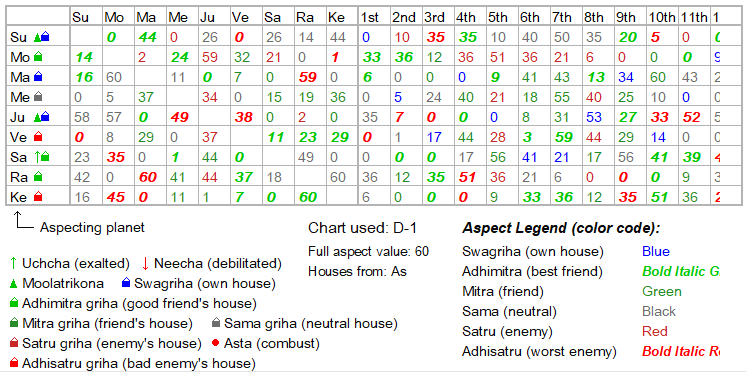
In Vedic astrology, aspects are personified in the sense that it is a planet casting its gaze. This gaze is "spread" across the signs that surround it, with the highest % (a full aspect) going to the sign directly across from it (7 signs from it) with lesser percentages as it gets close to it. In addition to that, the outer planets (Mars, Jupiter and Saturn) as well as the nodes (Rahu and Ketu) have additional signs that receive their full aspect. I was taught the nodes do, but many schools of thought do not have them with aspects, so I will only share the ones for the outer planets:
- Mars: 4th and 8th
- Jupiter: 5th and 9th
- Saturn: 3rd and 10th
Before going further into aspects it's important to understand benefic and malefic planets. Benefics normally bring benefit, and they are Jupiter, Venus and the Moon. Malefic planets normally bring challenges or suffering, and they are the Sun, Mars, Saturn, Rahu and Ketu. Mercury is considered changeable, although some schools consider it a benefic (I will not). Also, some schools consider the Waxing moon a benefic, while the waning moon is a malefic (I will not).
Back to the aspects - the image that I showed above takes into account the full gamut of aspects with the partial percent aspects included. But, for simplicity sake, we will only consider an aspect's significance if it is a full aspect and is based off of a planet being in the sign that receives that full aspect from another planet. In this case, aspects being received are:
- The Sun is receiving Jupiter's 9th aspect (a benefic aspect)
- The Sun is conjoined Mercury (a variable conjunction)
- The Sun is conjoined Venus (a benefic conjunction)
- Mercury is receiving Jupiter's 9th aspect (a benefic aspect)
- Mercury is conjoined the Sun (a malefic conjunction)
- Mercury is conjoined Venus (a benefic conjunction)
- Venus is receiving Jupiter's 9th aspect (a benefic aspect)
- Venus is conjoined the Sun (a malefic conjunction)
- Venus is conjoined the Mercury (a variable conjunction)
- The Moon is receiving Jupiter's 7th aspect (a benefic aspect)
- Jupiter is receiving Saturn's 3rd aspect (a malefic aspect)
- Jupiter is receiving the Moon's 7th aspect (a benefic aspect)
- Mars is receiving Rahu's 7th aspect (a malefic aspect)
- Mars is conjoined Ketu (a malefic conjunction)
- Rahu is receiving Mars' 7th aspect (a malefic aspect)
- Ketu is conjoined Mars (a malefic conjunction)
We will leave out Ketu and Rahu's exchanging aspects because that is always the case. Taking into account what we see above, we'd give each planet a "+1" for every benefic aspect or conjunction and a "-1" for the malefic aspects and conjunctions.
And we better not leave out the fact that we have Jupiter and Mercury both retrograde in this chart. That means that the native may have issues fully expressing the natural significations of those planets. So, for Jupiter and Mercury we would give them "-1".
Now we are starting to have an idea of which planets have good placements and which ones have challenging placements. For review:
- The Sun benefits from being in its own house, and its office, as well as receiving Jupiter's aspect and Venus' conjunction. (+3)
- The Moon benefits from receiving Jupiter's aspect. (+1)
- Mercury benefits from receiving Jupiter's aspect and Venus conjunction, but suffers somewhat from the Sun's conjunction, and being retrograde. (0)
- Venus benefits from receiving Jupiter's aspect, but also suffers a little from being conjoined with the Sun. (0)
- Mars benefits from being in its own house, but also suffers from Rahu's aspect and conjunction with Ketu. (-1)
- Jupiter benefits from being in its own house and its office, as well as the Moon's aspect, but it suffers from Saturn's aspect as well as it being retrograde. (0)
- Saturn benefits from being in its sign of exaltation/ (+1)
- Ketu suffers from being conjoined with Mars. (-1)
- Rahu suffers from being aspected by Mars. (-1)
Now we can start to "tally up" to see if the placements of these planets are beneficial or challenging. And I must say that this isn't necessarily accurate because it's an incomplete assessment. There can be factors that completely cancel out some of the negative or positive things that we went over here, but to keep things simple for purposes of learning, we're just going to look at it this way for now.
Understanding whether the planets have a good or bad placement is a foundation for understanding further parts of the chart. In the next article, we will start to use these evaluations to reflect on how they may affect a planet expressing its energies, and how that can play out regarding the house placements. But, even more importantly, assessing information this way can start to give us a glimpse into our inner selves. Maybe there are things that we are really good at that come naturally to us, or things that are very challenging. Much of the time, when people start to evaluate their charts in this way they notice that "this thing that comes very easy for me is related to this planet and this planet has a very good placement in my chart." Or the opposite "this thing that's very challenging for me is related to this planet and it has a very challenging placement in my chart." Once we start to look at our constitution through the perspective of astrology like this, it can start to reveal how the cosmos and laws of God and Nature govern our inner workings, and we can use this to our advantage to understand how to take action that results in the maximum benefit for all beings.