This is part 9 of an ongoing series of articles. If you haven't already please read parts 1, 2, 3, 4, 5, 6, 7 and 8.
In this article we are going to use our example native's chart to learn more about transits. Before reading this article I suggest going back through part 2 and skimming over that article since it was the overview on transits. Learning about the houses in one's chart is a significant undertaking with a huge payoff and after going through all of that over the past few months it's good to get a refresher. It was for me!
My preferred way of evaluating transits is to look at the natal chart image side-by-side with the current transits, so below are these two images. The first chart is the natal chart from our example, which is from August 22, 1984 at 8am in New York City. The second chart on are the transits at the point of our new moon on February 9th, 2024 at 5:59pm in Western NY.
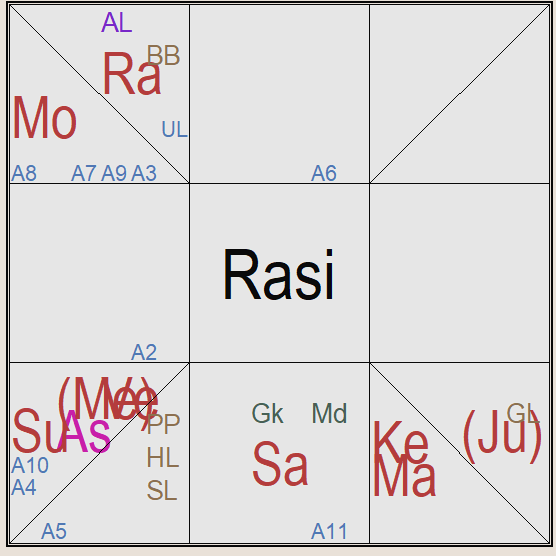
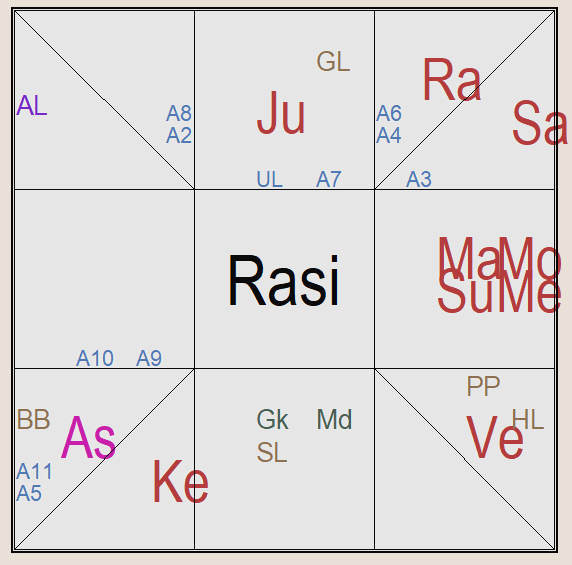
I do want to give credit where it's due to tropical astrology and its practitioners because I think their tools for dealing with transits are much more user-friendly. And, in the process of writing this I discovered what I think may be my favorite new method for observing transits. I wanted to show an image that tropical charts use as an example because they do overlays which make it easier to see everything at a glance. But the drawbacks for me have always been having the transit lines and some other data which I did not like. But, I found that Astro Seek has a Sidereal Transit Chart Generator that you can do quite a bit of customization to using the 'Customize Positions' button. Here's what I was able to generate, which I think helps dramatically:
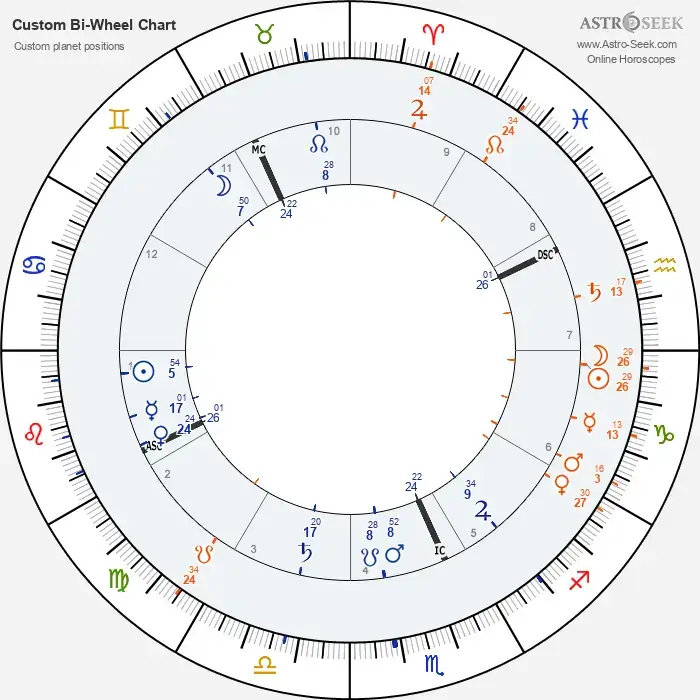
In this image, the outermost ring of the chart has the symbols for the Zodiac signs. The inner two rings have the symbols for the planets in them with their degrees beside them (larger number being the degree, smaller the minute). The orange colored planetary symbols are the positions of the planets and their degrees in transit. And the blue symbols in the innermost ring are the symbols for the planets and their degrees in our example native's birth chart.
Recapping some things from our second article in this series, the most standard things to look at when doing work with transits is to look for aspects and conjunctions. There are a few main perspectives I find valuable here; one being the aspects and conjunctions of the current positions of the transiting planets against the placement of the planets in one's natal chart; a second being the influence of transiting planets on the houses of our natal chart when there are no planets placed in them; and a third being the influence and conjunction of the current position of planets against each other.
In this article we are going to take the time to look at a the first two mentioned, and I am going to add a generic method of looking at transits, accounting for current positions only without taking into account any natal chart information. The main reason for doing this is because in our ceremonies this is what we do since it is a collective reading not taking into account any individual's natal chart. We will leave the evaluation of the aspects and conjunctions of the current transiting planets against each other (taking into account their natal chart roles) until next week. And, part of the reason why I want to do that is because looking at this chart I see something remarkable right from the start. There are almost no planetary positions in the natal chart that are conjoined current planets! The only one is Jupiter in the natal chart and Venus in the current transit both being in Sagittarius, and they're almost at opposite ends of the sign. I think there's a chance next month we'll be facing a further consolidation of planets up towards Aquarius / Pisces / Aries and we may have no conjunctions with natal positions at all, but a whole lot of action with those current conjunctions!
Accounting for Current Positions Only
When we reference transits only in the context of the current positions of planets, that means we aren't taking into consideration anything about houses, and we must focus solely on the planets being in certain signs and/or the 'personalities' of planets they are aspecting or conjunct with. This does kind of deviate from the path that we are on in our intro series where we are focusing on our example native's chart, but I wanted to include this since it will add perspective to the 'community readings' (or 'weather forecasts') that we do during our new moon ceremonies.
We'll use the following table as a reference; it should help quickly identify certain things in the transit and at the same time the columns in this table should help highlight the relevant things we are talking about here.
| Planet | Sign Placement | Conjunct | Aspecting | Receiving Aspects |
|---|---|---|---|---|
| Sun | Capricorn | Mars, Moon, Mercury |
|
|
| Moon | Capricorn | Sun, Moon, Mars |
|
|
| Mercury | Capricorn | Sun, Moon, Mars |
|
|
| Venus | Sagittarius |
|
|
|
| Mars | Capricorn | Sun, Moon, Mercury | Jupiter | |
| Jupiter | Aries | Venus | Saturn, Mars | |
| Saturn | Aquarius | Jupiter |
|
|
| Rahu | Pisces | Ketu | Ketu | |
| Ketu | Virgo | Rahu | Rahu |
When evaluating this information, the thing of highest importance are the conjunctions, followed by the aspects being received, with the sign the planet is placed in being of less significance.
It doesn't take the table to understand that the major thing of interest in these current transits, outside of any knowledge of a natal chart, is the conjunction of the Sun, Moon, Mars and Mercury in Capricorn. To evaluate this I'd take into account the personalities of the planets and them being in Capricorn. I see the Sun, who is the natural lead masculine planet and life giver, the Moon who is the natural lead feminine planet and nurturer, Mars who is the masculine warrior force, and Mercury who is the gender-neutral intellectual. I am greatly simplifying this because I want to keep this section brief.
The first thing I think of looking at this is as though the Sun and Moon being the mother and father, together with Mars and Mercury, their children, in Capricorn, the sign of action. In my mind this comes through as a family unit working together to get something done. Or, I may choose to slightly change the roles of the planets from a family into something like a king's court or the executives of a business. I would still look at it as a group collaboration in the sign of action. So, evaluating this part of the transit I may think of it as a time where the energies are creating some type of scenario for collaboration between these types of entities or roles.
That may not necessarily be a pleasant thing, though. The collaboration could be wrought with challenges, or be very easy-going. We'd want to look at some of the things we discussed in part 3 that are simply about evaluating the strength of planets to get details. The most significant thing that we have in this case is that Mars is exalted in Capricorn. So, overall, the energies of conjunction may have support in a way in harmony with Mars' energies. Or, to look at it from another perspective, there may be opportunity for us to make this conjunction one that is beneficial by tapping into those exalted energies of Mars.
The other relevant things here are the aspects being received. We can consider Jupiter receiving the aspects of Mars and Saturn. So, Jupiter, the great male benefic; the expansive guru, may be dealing with the effects of the malefic males, Saturn and Mars. Saturn, being a constricting planet, may put a limit on the expansive nature of Jupiter. Mars, although a malefic, is exalted, so rather than being something harmful, it may be like an energetic warrior-like boost. I'd think of these in the the sense of collective energies rather than personal. The other relevant aspect being received is Ketu being aspected by Mars, which we could apply similar principles to based on the significations of Ketu.
Accounting for Natal Positions
When accounting for the natal positions, we are evaluating the conjunction and aspect of the current positions of planets in the sky compared to the position of planets in the natal chart. This table we can use as a reference to help digest this information in an easier format.
| Planet | House Rulership | Current Placement |
Natal Planet Conjoined |
Natal Planet Being Aspected |
Natal Planet Receiving Aspect From |
|---|---|---|---|---|---|
| Sun | 1st | 6th House (Capricorn) |
|
|
|
| Moon | 12th | 6th House (Capricorn) |
|
|
|
| Mercury | 2nd and 11th | 6th House (Capricorn) |
|
|
|
| Venus | 3rd and 10th | 5th House (Sagittarius) | Jupiter | Moon | Moon, Saturn (3rd Aspect) |
| Mars | 4th and 9th | 6th House (Capricorn) | Sun, Mercury, Venus (8th Aspect) |
|
|
| Jupiter | 5th and 8th | 9th House (Aries) |
|
Sun, Mercury, Venus (5th Aspect), Jupiter (9th Apsect) | Jupiter (5th Aspect), Saturn (7th Aspect) |
| Saturn | 6th and 7th | 7th House (Aquarius) |
|
Sun, Mercury, Venus (7th Aspect), Ketu and Mars (10th Aspect) | Sun, Mercury, Venus (all 7th Aspect), Mars (4th Aspect) |
| Rahu | 4th | 8th House (Pisces) |
|
|
|
| Ketu | 7th | 2nd House (Virgo) |
|
|
|
In this table the first column is the planet; the second column is the houses it rules over in the natal chart; the third column is the current placement of the planet in the Zodiac; the fourth has any conjunctions between the planet in its current place in the sky with the position of planets in the natal chart; the fifth is planets whose position in the natal chart is a sign that the planet is currently aspecting; the sixth is planets who, based on their position in the natal chart, would be aspecting the planet in its current position. If you look at some of the tables that we were using when evaluating the house placements of planets in previous articles, you may be able to notice the way some of the data in this chart is directly related.
One thing I want to point out as well is that in our chart with planets placed in signs during transit, the ascendant is in the same place as it was in the natal chart. This is not a common occurrence. The ascendant changes by the hour since it's the sign on the horizon. Choosing a time that the ascendant is in the same place as the natal chart is by pure chance, and somewhat irrelevant as well. I just don't want anyone looking at that thinking about it for more than it is.
The most significant thing I want to look at during transits is whether there are any planets that are conjunct with the natal position of planets. In the transit we have selected, there is only one, and that is Venus currently being in Sagittarius is conjoined with the natal position of Jupiter in Sagittarius. To evaluate this, the way I like to think of it is "Venus, the ruler of the 3rd and 10th houses, is conjoined natal Jupiter, the ruler of the 5th and 8th houses, in the 5th house." When considering the current placements of planets in the sky, I find it more useful to use the evaluation as of a way to reverse engineer what's going on in my life and to make sense of it through the chart.
To do that, let's refer to some of the significations of the 5th house, which we explored in part 6 of the series. The 5th house has to do with creative intelligence, children, and luck as it relates to karma. For our native, it has the influence of Jupiter from birth, so we can imagine these significations 'painted' by this influence. And, in the current transit, we have Venus bringing her influence to the table, which could be as the ruler of the 3rd and 10th or simply Venus' personality traits. If I have evaluated my natal chart and have an understanding of the role that the 5th house plays for me, I may want to look at those areas of my life to see if any of it can be explained by Venus being present. Maybe I have children, and I'm going through a period where I am busy with a lot of activities (taking action, 10th house) with them. I could see if the transit that Venus, as ruler of the 10th, is bringing that influence into my 5th house and think "oh that explains it." There is actually some support for the idea that this could happen because not only is Venus bringing its influence into the 5th house, but the natal Jupiter is also Lord of the 5th house. So we have Jupiter, Lord of the 5th, in the 5th in the natal chart, being influenced by Venus in the current transits. There's more "activity" there to support the idea this interaction could be manifesting something significant in our example native's life.
The last significant thing that I want to focus on in this chart is the dual aspect of Saturn and Jupiter on our native's 1st house, or ascendant, in Leo. These heavy hitters are casting their gaze on the first house where the natal Sun, Mercury and Venus are. This is more likely to result in some activity manifesting in the life of our example native because of all of the energies involved. You've got the aspects of rulers of houses 5-7 influencing the things of the 1st house and at the same time, by extension, potentially influencing things of the 1st house (Sun's rulership), 2nd and 11th (Mercury's rulership) and 3rd and 10th (Venus' rulership).
Transiting Planets over Native Houses
Another type of interaction is when a transiting planet places its influence on a sign without any planets in it in the natal chart. Depending on the amount of time it the planet will spend in that sign, we may want to pay significant attention to it. For example, when Jupiter or Saturn are transiting houses that can happen for 10+ months, so their energies being stationed in that house for that long is certain to have some kind of effect, although potentially very subtle.
A simple case of this is when a single planet is influencing a house either by being in it or aspecting it. Let's take Rahu, for lack of a better example. Rahu is the ruler of the 4th (in some Vedic schools), and is currently in Pisces. Pisces is the 8th house, and has no planets in it in the natal chart. So Rahu brings its energies as himself, as well as ruler of the 4th, into the 8th house, but other than that not really much is going on. The 8th house being a dusthana (house of suffering), and the 4th being related to the mother, or home, may mean there's energetic support for difficulties manifesting relating to the home or the native's mother. But, this simple transit without any additional influence may not be enough to support that. Same goes for Rahu's aspect on Virgo. Virgo is the 2nd house for our native, with no planets in it. Rahu's aspect as the 4th lord may bring a tiny bit of influence into the realm of the 2nd house. Nonetheless, if one was looking at their chart to understand things related to the 2nd house (money, sustenance, etc) that aspect by Rahu is something of importance, along with evaluating the lord of the second.
There are two worthwhile examples to take into account here in regards to transits not affecting any natal planets. One relates to what we evaluated in a previous section of the four planets conjoined in Capricorn. Capricorn is the 6th house for our example native; and having four planets currently transiting that 6th house could mean a lot of activity related to its significations such as challenges or opposition. And that may affect the whole gamut of houses that those transiting planets rule over (1,2,4,9,11,12).
The other that is worth mentioning because I do it in our ceremonies frequently, is the dual influence of Saturn and Jupiter in Aries. Aries is the 9th house for our native, and Jupiter is currently transiting it and Saturn is currently aspecting it. So, we may want to look at this in the sense that there could be big things going on related to significations of the 9th house for our native, and they may be influenced by things of the 5th and 8th (houses Jupiter rules) or 6th and 7th (houses Saturn Rules).
Stepping Back
I'm expecting that for most beginners, their heads may be swimming after hearing some of this; it's a difficult set of information to digest. Normally, one would take months if not years studying and coming to understand their natal chart along with the influences and relationships between planets, signs and houses before moving onto transits. Unfortunately, for our article format, it doesn't really make sense writing a dozen more articles with different natal charts to start to really tune into how these things play together. So, what I've tried to do here is just try to show the complexity across a range of examples, with a few specific things thrown into the mix to help drill down for those interested. Still, you might be feeling like this.
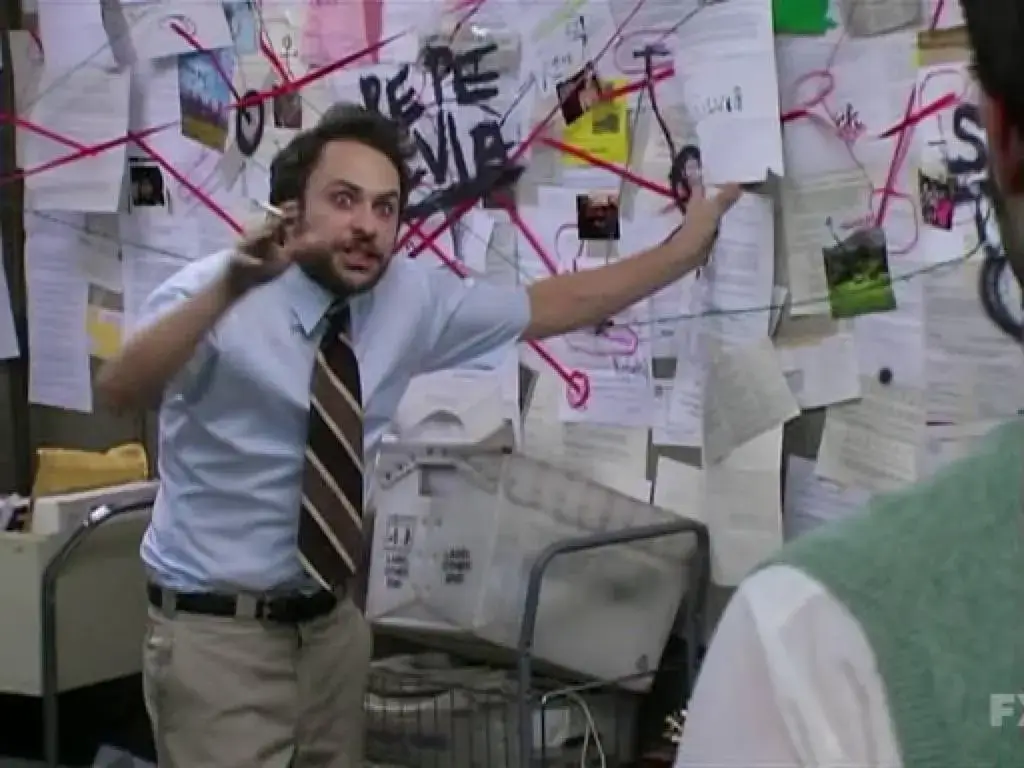
If you do, that's to be expected; don't fret! If you don't, congratulations, you might be a natural ;)
Another thing I want to hit back on is what I said earlier in this article about using this as a way to reverse engineer what's going on. There's two main ways I will use transits. The 'reverse engineer' phrase I mentioned means that I may just have some things going on in my life, and I'll look at the transits to try to figure out what stellar influences are at play. So, rather than doing tables and charts and laying everything out like we did here for every transit, I'll approach it like "man, I'm really stressed lately at work. Let me take a look at the current transits to look for anything related to my 10th house or the lord of the 10th." The other may be for trying to prepare for future events (which is a very popular use for astrology). So, if I want to know the best time to change careers, I look at the transit of planets over the next few months or to see if/when there is something significant related to my 10th house that seems like it supports a change of careers. I'm mainly saying this here to help clarify that the complexity of this article isn't an accurate reflection of using astrology in practice. It's more complex here because we're just coming up with everything and anything based on the transits; while in a real world application we'd have specific things we'd be looking for and it would be a much more narrow set of information we'd deal with.
The 10,000 ft takeaway here is that, from our natal chart, we end up with the houses, and the planets that rule those houses. We use that as a basis for understanding our nature. This helps us get in tune with nature and its laws along with God. Once we develop this sense for what's going on, we apply that to the current transits of planets. We know the houses that the planets rule, and as time passes and they move throughout the Zodiac, they brings those influences, along with their natural personality, into the houses they are visiting. All the while, this is going on with dozens of stellar bodies that interact to lay the foundation for the plethora of possible experiences we can have in life. And us, as the free-willed beings, make decisions about how to act and respond to these circumstances to carry on our lives, which continually sets the stage for the days to come.
Thank you for sticking it through this far! In our next article, we are going to take another look at transits. Then, it will be in regards to the interaction of the planets with each other in their current positions. We will not be considering the natal positions of planets, but we will be taking into account their rulership from the natal chart.