In the core 10 parts of this series, we've walked through an overview of astrology from the foundational building blocks through reading and understanding one's own birth chart to understanding transits. The purpose of doing this was because in my personal experience with astrology, it helped me cultivate inner knowing and strengthen my connection to God, and I wanted to share that with our church community.
If you haven't already read the core 10 parts of the series, or listened to them read during our ceremonies, it's highly suggested to go back and read through them. In this part, we will recap everything, and rather than just walking through each part we'll group information from different parts that go well together to keep it concise, help with presentation, and also elaborate on some information since it suits this format well.
As part of our new moon ceremonies we review the transits of the upcoming lunar cycle, and we do this based off of my experience with Vedic astrology (Jyotish) using sidereal time. The resources we've used throughout the intro series as well as in our ceremonies is the book Path of Light Vol 1 and the software Jagannatha Hora so if you are interested in using astrology as a tool for your own personal development I highly suggest these as they have been invaluable for me.
When we first start to learn astrology we learn about the signs and the planets. There are 12 signs in the Zodiac, and 9 bodies we consider in Vedic astrology. Out of those 9 bodies, 7 are considered 'planets', and the other 2 are the north and south nodes of the moon, which are points in the sky mathematically derived based on the movement of the bodies in the sky. Of the 7 planets, 2 are the luminaries, the Sun and the moon.
Each sign in the zodiac is ruled by a planet. The 2 nodes of the moon also co-rule a sign, although that isn't the case in all astrological schools of thought. Signs also have an element and modality. We didn't go much into the elements or modality in our articles but they have come up in our ceremonies. There are 3 signs of each element, 4 signs of each modality.
The elements each carry a certain nature or intelligence, and signs that share an element similarly express its characteristics. Modalities carry a certain type of energy, and signs sharing a modality also express its characteristics in their own way. For modalities, Cardinal is like "birthing action" or beginnings (the Sun traverses signs with this modality at the start of a season); Fixed being sustaining (signs with this modality experience a season in its fullness); and Dual being changing (signs with this modality experience the end of one season changing into another). When you combine the 4 elements with the 3 modalities it gives all 12 signs. So another way to look at this is as if each sign is the expression of the energy of an element according to the energy of a modality.
Here's a quick reference table showing the ruler, element and modality of each sign:
| Sign | Ruler | Element | Modality |
|---|---|---|---|
| Aries | Mars | Fire | Cardinal |
| Taurus | Venus | Earth | Fixed |
| Gemini | Mercury | Air | Dual |
| Cancer | Moon | Water | Cardinal |
| Leo | Sun | Fire | Fixed |
| Virgo | Mercury | Earth | Dual |
| Libra | Venus | Air | Cardinal |
| Scorpio | Mars, Ketu (co-ruler) | Water | Fixed |
| Sagittarius | Jupiter | Fire | Dual |
| Capricorn | Saturn | Earth | Cardinal |
| Aquarius | Saturn, Rahu (co-ruler) | Air | Fixed |
| Pisces | Jupiter | Water | Dual |
Each planet also has a basic nature which would be benefic (beneficial) or malefic (challenging or potentially harmful). In addition to having one or more signs they rules over, each has a sign of exaltation where it expresses its energy fully, and a sign of debilitation where it struggles. Although we haven't touched on houses yet, each planet also has a house where it "dies" or Marana Karaka Sthana (a challenging house placement).
Planets also have aspects which is where they are looking in the chart. In Vedic astrology, they are expressed as the number of signs away that the planet "looks" with its current sign included. So, a planet's 2nd aspect would be the sign one in front of the sign it is in. All planets have a 7th aspect, which is them looking at the sign directly across the Zodiac. The outer planets, Mars, Jupiter and Saturn also have two additional aspects. These can be more complex but for this intro we'll leave it at that.
This table shows this info for each planet, including the sign(s) they rule over:
| Planet | Nature | Exaltation Sign | Debilitation Sign | Aspect(s) | Rules Over | Marana Karaka Sthana |
|---|---|---|---|---|---|---|
| Sun | Malefic | Aries | Libra | 7th | Leo | 12th house |
| Moon | Benefic | Taurus | Scorpio | 7th | Cancer | 8th house |
| Mars | Malefic | Capricorn | Cancer | 7th, 4th, 8th | Aries, Scorpio | 7th house |
| Mercury | Benefic / Malefic* | Virgo | Pisces | 7th | Gemini, Virgo | 4th and 7th houses |
| Jupiter | Benefic | Cancer | Capricorn | 7th, 5th, 9th | Sagittarius, Pisces | 3rd house |
| Venus | Benefic | Pisces | Virgo | 7th | Taurus, Libra | 6th house |
| Saturn | Malefic | Libra | Aries | 7th, 3rd, 10th | Capricorn, Aquarius | 1st house |
| Rahu | Malefic | Gemini | Sagittarius | 7th | Aquarius | 9th house |
| Ketu | Malefic | Sagittarius | Gemini | 7th | Scorpio | 4th house |
*Mercury has a fickle nature and can change its disposition based on planets it may be conjoined with or other factors.
This core info about the signs and planets never changes. These could be considered the basic building blocks of astrology.
To start to play with this information, we like to use a chart showing us the placement of planets in signs at a given point in time from a specific location. The first step in using astrology to know ourselves, is to study our natal chart, which shows the placements when we were born. We can use astrology software to do this. What we need to get an accurate chart is the place and time we were born, which we input into software to have it show us a chart. If we don't have this info, and we can't get it from our parents, most people can get a copy of their birth certificate which has it.
Once we have a chart, another variable is added to the mix - the Ascendant or Rising Sign. This is the sign that is on the horizon at the time and place used to generate the chart. The sign of the Ascendant becomes the first house. In the way we reviewed, each house is a full sign, starting with the first house being in the Ascendant, the second in the next sign, and so on up until the 12th house.
Charts come in different styles in Vedic astrology. We used the eastern style chart that has Aries always at the top center square as a useful reference for finding what sign a planet is in. We also used the northern style chart where the first house is always in the top square as a useful reference to see what house a planet is in. The signs go in a anti-clockwise order. The image below is a screenshot of Jagannath Hora using example birth data we came up with, August 22, 1984 at 8am in New York City. The eastern style chart is on the left and the northern style chart is on the right.
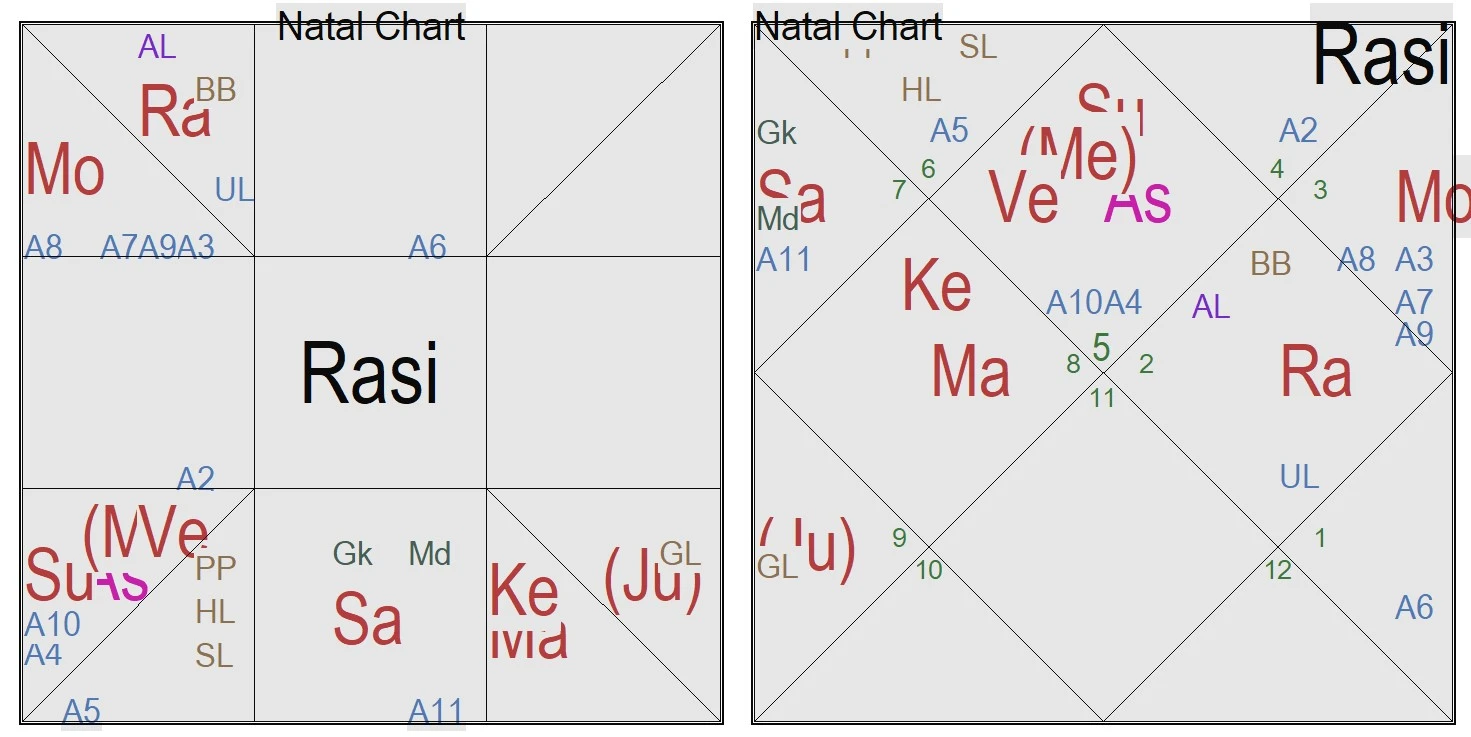
Houses can be said to represent 'realms of experience' we encounter in life. Think of things like 'my experience with my mother' or 'my experience as a mother' (which would be the 4th house). And each house has many of these things they correlate to such as members of our family, education, health, etc. There are also groupings of houses or 'themes', such as those related to growth, luck, wealth, spirituality, challenges, obstacles, suffering and more.
At this point we have the static building blocks of the signs and planets, and we've added the dynamic components of the house and planetary placements. We described this interplay as the planets being people with personalities, signs being land or terrain, and houses being realms of experience. We can imagine this interplay of planets being placed in a sign and house like people being in places and those places being grounds for certain types of experience.
Once we know the placements we can start to evaluate planetary strength. Some things to consider are:
- What sign is it placed in? It's sign of exaltation or debilitation? A sign it rules over? A sign ruled by a malefic or benefic, a friend or foe?
- How is it being affected by other planets? Is it conjoined (in the same sign) as a benefic planet, or a malefic planet? Is it receiving aspects, and what is the strength and nature (malefic or benefic) of those planets?
- Is it retrograde, or is it direct?
- Is it in its house of death, or Marana Karaka Sthana? Or one of good fortune, or suffering?
We will keep the strength assessments related to houses in mind, but not really use it in our initial "calculations" since positive experiences can come from challenging house placements and vice-versa.
The table below is a combination of two tables we created; the very rudimentary strength evaluation and the planetary placements. Once we get the hang of these things, this wouldn't be a normal practice, but it's great to help illustrate for beginners. Keep in mind, that our native's Ascendant was in Leo.
| Planet | Benefits | Disadvantages | Overall | Ruler Of | Placed In |
| Sun |
Own House and Office Jupiter’s aspect Conjoined Venus |
|
+3 | 1st |
1st (Leo) |
| Moon | Jupiter’s Aspect |
|
+1 | 12th | 11th (Gemini) |
| Mercury |
Jupiter’s aspect Conjoined Venus |
Conjoined Sun Retrograde |
0 | 2nd and 11th | 1st (Leo) |
| Venus | Jupiter’s aspect | Conjoined Sun | 0 | 3rd and 10th | 1st (Leo) |
| Mars | Own House |
Conjoined Ketu Rahu’s aspect |
-1 | 4th and 9th | 4th (Scorpio) |
| Jupiter |
Own House and Office Moon’s Aspect |
Saturn’s aspect Retrograde |
0 | 5th and 8th | 5th (Sagittarius) |
| Saturn | Exalted |
|
+1 | 6th and 7th | 3rd (Libra) |
| Ketu |
|
Conjoined Mars | -1 | 4th* | 4th (Scorpio) |
| Rahu |
|
Mars’ Aspect | -1 | 7th* | 10th (Taurus) |
Having the planetary strengths figured out, we now have our first insight into how these stellar influences play into our lives. Each of the planets has its own significations, very related to what we described previous as 'personality'. Mercury being related to communication, Venus signifying art and creativity, Jupiter for expansion and philosophy, etc. We can start to go through each planet and its significations, and in kind of reverse-engineering approach, see if/how what we are seeing in our evaluation manifests in our lives.
For example; we may have great communication skills and it just so happens that we have a very strong Mercury; or maybe we are disinterested in art or creative matters and it turns out that our Venus is very weak. In both of these circumstances, we may think "oh well that kind of makes sense" and we can integrate into our understanding of our selves the roles these planets play in our lives. For many this part of studying may be a light bulb moment that really gets them more in touch with themselves, these patterns in nature, and their creator.
While there may be a few of those light bulb moments through this part, chances are there are some things that just don't make sense, or are left unanswered. That's because we've just barely scratched the surface of our journey of self-discovery, and the majority of that is going to happen through our evaluation of the houses. The next table has info from the perspective of the 12 houses in our native's chart.
| House | Sign | Ruler | Occupants | Receiving Aspect |
| 1st | Leo | Sun | Sun, Mercury and Venus | Jupiter |
| 2nd | Virgo | Mercury | ||
| 3rd | Libra | Venus | Saturn | |
| 4th | Scorpio | Mars, Ketu* | Mars and Ketu | Rahu |
| 5th | Sagittarius | Jupiter | Jupiter | Moon, Saturn |
| 6th | Capricorn | Saturn | ||
| 7th | Aquarius | Saturn, Rahu* | Sun, Mars, Mercury, Venus | |
| 8th | Pisces | Jupiter | ||
| 9th | Aries | Mars | Jupiter, Saturn | |
| 10th | Taurus | Venus | Rahu | Mars, Ketu |
| 11th | Gemini | Mercury | Moon | Mars, Jupiter |
| 12th | Cancer | Moon |
Armed with an understanding of the basics, an assessment of the strengths (and/or weaknesses), and our handy dandy reference charts we proceeded to go through the houses one by one to start to figure out how the significations of that house express in our lives.
We started this venture reading up on the significations of a house. Maybe the house has to do with children, siblings, luck, spirituality, obstacles, health, or challenges. Then we would look at what things in our chart are affecting the house. Of primary importance are planets in the house and the placement of the lord of the house. This would be another reverse-engineerING assessment where we first take account of our life and then look to explain it in the chart.
For example, if I had issues with my mother, or being a mother, I may look at the 4th house and notice that there are weak planets in it or that its lord has a weak placement. Or maybe I had always had excellent luck with establishing meaningful relationships and realized that my chart had strong planets in the 7th its lord was also strong. The key here is always that we are looking to find if there are things about our lives, both inner and outer, that seem to have obvious representations in our chart. I've never come across a scenario where this isn't the case for someone.
The understanding of the house placements, and the interplay of these energies is in my opinion one of the biggest **mind explosion** throughout the process of learning astrology. Do these patterns in nature influence us? Or, as beings created in this nature, do we just so happen to naturally follow these patterns? Meditating on these questions we can strengthen our bond with nature and God. And, as part of being more informed on our inner and outer workings, we can start to make decisions that improve the lives of ourselves and ultimately the whole.
Evaluating transits was the final part of our intro series. Culminating here naturally fit because our new moon ceremonies involve observation of the transits, and for everyone interested in personalizing this part of our ceremonies this intro is enough to get one on the right foot.
When doing planetary transits using vedic charts, a beneficial approach is to look at one's natal chart side-by-side with the chart of current planetary placements. Tools that use tropical style charts also have very convenient styles for doing transit evaluations. The first images below use the vedic style to show our example nativity chart alongside the planetary transits. The third image shows the natal placements in the color blue with the current transits in the color orange in the same image.
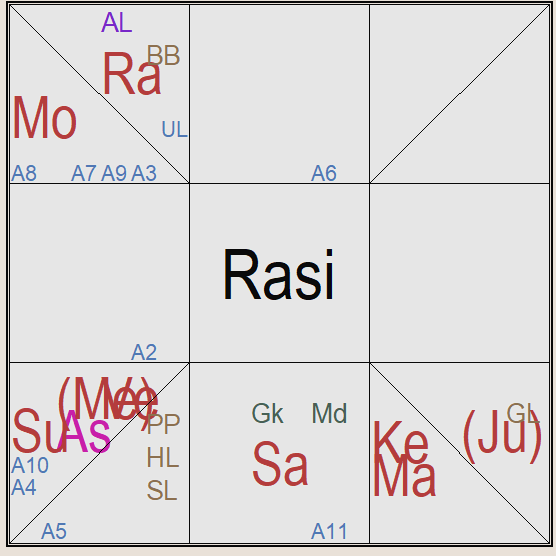
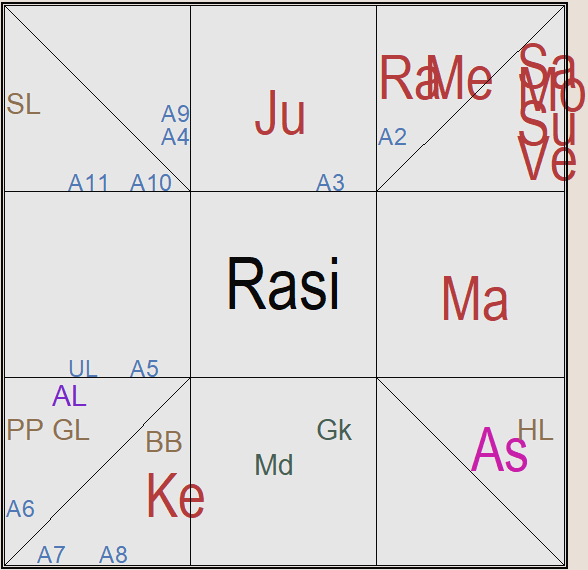
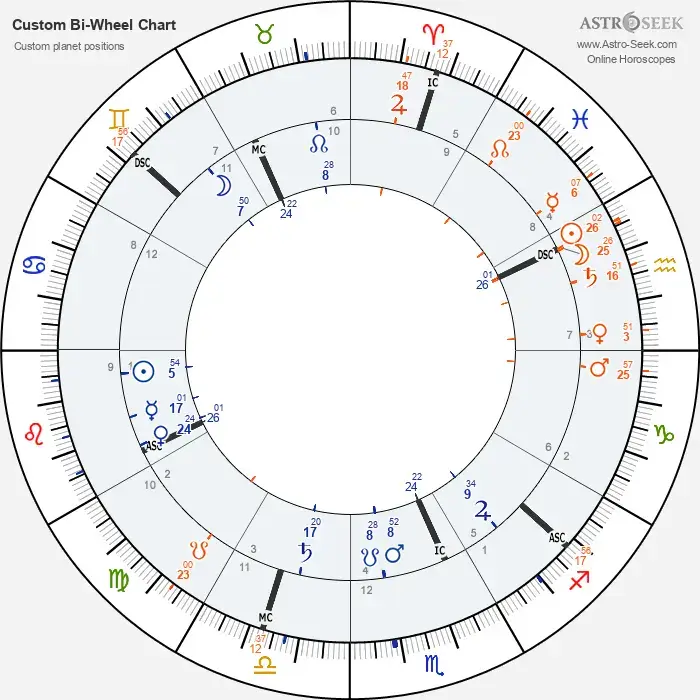
The most significant things to look for when evaluating the transits are whether there are any planets whose position in the sky now correlates to the position of a planet in our natal chart. One that we all know of, but don't always think of it this way, is our solar return. When the Sun returns to the same spot in the sky that it was when were born, that means it's our birthday!
With seeking information regarding transits we can take the reverse engineering approach we've described before. So, if we are experiencing relationship issues, we can look to our charts to see if there is anything there explaining the situation. For example, maybe there are malefic planets transiting the sign that our 7th house is in, or maybe the lord of our 7th house is currently transiting its sign of debilitation. How this comes in handy is that once we know the roles that these planets play in our lives, we can figure out things we may be able to do to mitigate the issue. So maybe we can do things to "boost" the lord of our 7th house, or any applicable planet, such as making offerings or saying prayers. Or maybe we take a much more practical approach and just decide that based on our chart, our partner and ourselves would do best focusing on things related to other areas of our chart that are more supported during the transit.
In addition to the reverse engineering approach, we can use transits to try to make predictions or plans. Say we want to change our career path and are looking for the best time to act. The Sun is a planet that frequently signifies career in the western world, and the 10th house is the one most commonly associated with it as well. We may open our astrology software, and start to "browse" at the changing placements day by day until we find an opportune time such as when the Sun is strong, and the lord of our 10th house is in its sign of exaltation, or when another benefic planet is stationed in our 10th house, and the Moon is simultaneously transiting it.
And that, in a nutshell, is it! Okay okay okay maybe a nutshell is undershooting it quite a bit. But the value and payoff of learning and integrating this information is inestimable. Not only do we open up the practical benefits of being able to use this information to help us make better decisions, but we start to see how these stellar influence and patterns in nature are part of who we are. We start to know ourselves better, which can bring confidence, happiness, and other benefits. And best of all, it further connects us to all that is, so that we may then use this newly integrated knowledge and experience for the benefit of all beings.
Thank you so much for sticking around through our series! We hope you've found it informative. If you are new to astrology and found this interesting, an easy way to help integrate this information would be to go back and read parts 1-10 again. You've done the intro journey, and we've finished off with this recap which also presented the information slightly differently now that it had all been covered. Going back through will give you further perspective on each part and help them make more sense. Better yet, get started yourself by buying some books, learning how to use the free software, and start to do the things we've laid out here for yourself with your own nativity chart, and let us know how it goes :D